Modern infrastructure projects demand high levels of accuracy, traceability, and long-term reliability. However, many inspection and verification processes within tunnel construction still rely heavily on manual assessment. This challenge formed the foundation of the DATA-IS project.
DATA-IS, or Digitally Assured Tunnel Assets – Information System, was developed as part of a First-of-a-Kind (FOAK) competition funded by High Speed 2 Ltd. Led by i3D robotics alongside partners Costain, Tunnel Engineering Services (TES), and the Manufacturing Technology Centre, the project explored how intelligent inspection technologies could improve assurance, verification, and future asset management within tunnel infrastructure projects.
The challenge of tunnel asset verification
Tunnel environments contain extensive mechanical and electrical infrastructure, including cable management systems supported by thousands of wall-mounted brackets. Traditionally, operators install these brackets manually. However, once installed, verifying whether each fixing meets the correct tolerances becomes extremely difficult. Inspectors must confirm several critical factors, including:
- Correct bracket positioning
- Fixing angle and alignment
- Installation tolerances
- Torque compliance
- Overall installation quality
Manual inspection methods can become time-consuming, inconsistent, and difficult to scale across major infrastructure projects. As infrastructure networks grow larger and more complex, operators increasingly need automated systems that deliver accurate, repeatable, and traceable inspection data.
Building on the ATRIS project
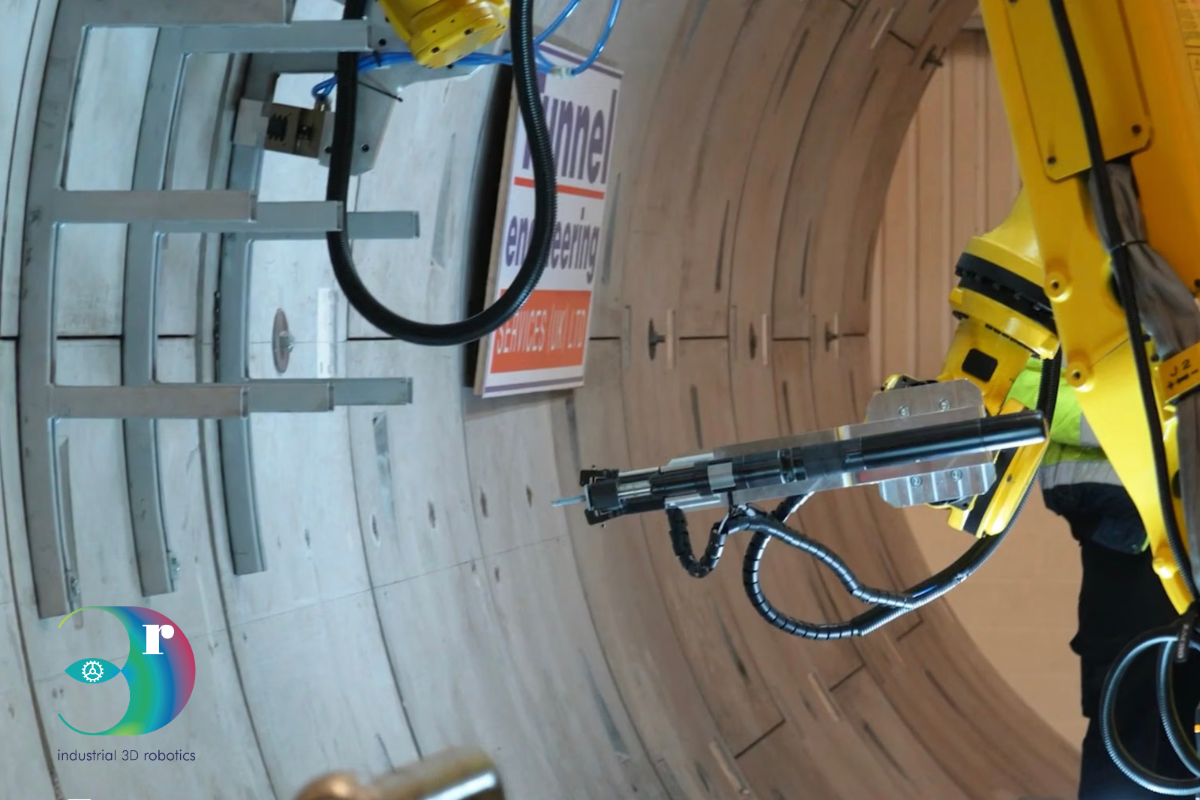
The DATA-IS project built upon earlier work developed through the ATRIS programme, which focused on automating the installation of tunnel support brackets. While ATRIS addressed the installation process itself, DATA-IS focused on inspection, verification, and assurance. Using the ATRIS robotic platform as a testbed, the consortium demonstrated how intelligent inspection technologies could integrate with larger automated infrastructure systems. This approach allowed the project team to test not only the inspection software itself, but also the wider interoperability of robotics, sensing, AI, and digital asset management technologies.
A first-of-a-kind inspection system
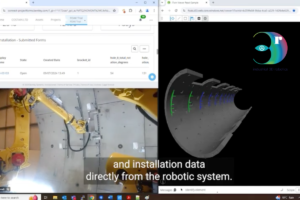 One of the project’s most significant innovations involved software developed by Dr Kinyip Chan at i3D. The system used stereo vision, robotics, AI, and digital twin technologies to automatically analyse installed tunnel brackets and determine whether the fixings met the required tolerances. Importantly, this capability had never previously been demonstrated within tunnel infrastructure inspection. The software could automatically assess installation quality, identify deviations, and flag potential issues requiring further attention. This reduced reliance on manual interpretation while improving consistency and traceability.
The innovation attracted significant industry attention and featured in several engineering and infrastructure publications, including Construction Management Magazine and The Civil Engineer.
Integrating technologies for intelligent tunnel inspection
Highlighted in this video, a key strength of the DATA-IS project involved the integration of multiple advanced technologies into a single operational workflow. The system combined:
- Stereo vision and 3D imaging
- Artificial intelligence
- Robotic automation
- Digital twin technologies
- Intelligent inspection software
Together, these technologies created a data-driven inspection and assurance system capable of supporting construction, verification, maintenance, and long-term asset management activities. Rather than functioning as isolated tools, the technologies worked together to generate actionable operational insight. This integrated approach aligns closely with the future direction of intelligent infrastructure management.
A measurable operational impact
The DATA-IS project demonstrated several tangible operational benefits for future infrastructure construction and inspection activities. These included:
- Reduced health and safety risks through fewer operatives working at the tunnel face
- Improved delivery times through continuous automated processes
- Reduced rework through real-time quality assurance and verification
- Improved document control and traceability
- More consistent installation validation and technical assurance
By integrating intelligent inspection directly into the installation workflow, the system helped demonstrate how automated assurance technologies could support safer, faster, and more efficient infrastructure delivery.
“Being involved with this project from concept to point of deployment has been a privilege. The intelligent tunnel inspection technologies the consortium partners and we have developed represent a sea change for the construction sector, truly a First of a Kind with the demonstrated ability to revolutionise infrastructure-building processes.”
~ Dr Richard French, Innovation Lead, i3D robotics
Beyond rail infrastructure
The success of DATA-IS and ATRIS continues to influence further collaborative development work.
Current collaborations involving Nuclear AMTC, Milne Research Ltd, KAMRI, the Advanced Manufacturing Technology Centre in South Korea, and commercial partner KIOT are expanding the digital twin and integrated visualisation capabilities originally demonstrated through the project. These developments aim to create fully integrated virtual environments that combine 3D models and operational data. These allow infrastructure systems and installation processes to be validated before work begins.
While the FOAK competition focused on rail infrastructure and future HS2 applications, the wider approach offers significant potential across multiple sectors. Applications could extend into nuclear, petrochemical, energy, and other heavy industrial environments where precise installation, automated assurance, reduced workface exposure, and long-term asset traceability remain critical operational priorities. Projects such as DATA-IS demonstrate how integrated sensing, intelligent inspection, robotics, and digital twin technologies are beginning to reshape modern infrastructure delivery and industrial asset management.
At i3D robotics, we continue to develop intelligent industrial solutions that combine advanced technologies to solve complex operational challenges across demanding industrial and infrastructure environments.